Ceramic Coatings
What “9H hardness” actually means on a ceramic coating, and why some brands claim 10H
The pencil hardness scale stops at 9H. We read what fifteen coating brands publish: who cites a test standard, and who claims a result above the maximum.

By Coy White, Co-founder, Creative and Technical Lead, ShineMD
Coy White works for Shine Master Detailers LLC, which makes ShineMD.
“9H” is printed on more coating bottles than any other number in this industry, and almost nobody selling it explains what test produced it. So we went and read what fifteen brands actually publish about hardness. Three of them claim a result above the top of the scale.
The scale is a box of pencils
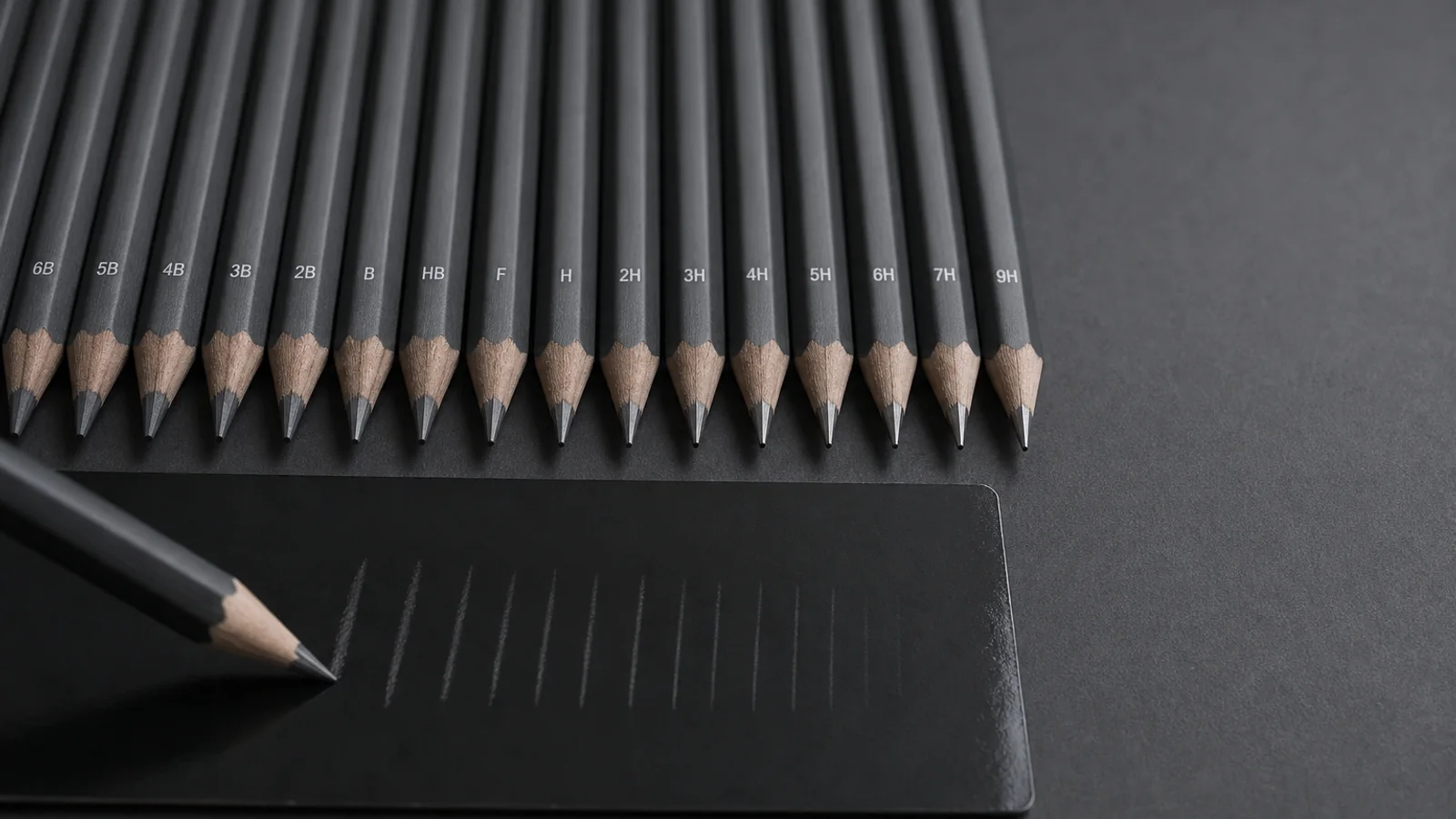
Pencil hardness is a real, standardised test. You draw a graded pencil across a cured film at a fixed angle under a fixed load and record the hardest grade that does not scratch it. The two standards you will see cited are ASTM D3363 and JIS K5400.
The grades run from 6B, which is very soft, up through B, HB, F and the H grades to 9H. That is the end. 9H is the hardest pencil in the set, so it is the highest result the test can return — not because coatings cannot be harder, but because the test has run out of pencils.
This matters for two reasons. A 9H result means “not scratched by the hardest pencil we own”, which is a much weaker statement than it sounds. And a claim of 10H is not a better score on this scale; it is a number from outside it.
The test is also measuring the wrong thing for most buyers. Pencil hardness describes resistance to a graphite point under load. It says nothing about resistance to a wash mitt dragging grit, which is what actually puts swirl marks in your paint.
Nine is the ceiling, and three brands went past it
From what each brand publishes on its own pages:
| Brand | Hardness claim | Test standard cited |
|---|---|---|
| Gtechniq | “10h paint protection”, “hard 10h top and softer 7h base layer” | None |
| Adam’s Polishes | “>10H Hardness”, introduced as “verified” | None |
| Ceramic Pro | “Above 9H” | JIS K5400 |
| System X | “Pencil hardness 9H”; separately “classified above 9H” | JIS K5400 |
| Opti-Coat | “Superior resistance to scratching (9H)” | None |
| CarPro | No hardness figure published | — |
| Gyeon | No hardness figure published | — |
| Modesta | No hardness figure published | — |
| Feynlab | No hardness figure published | — |
Two observations from that table, and both are more useful than the numbers in it.
Only two brands cite a test standard at all. Ceramic Pro and System X both name JIS K5400. Everyone else claiming a hardness figure gives you a number with no method attached.
The two that cite the standard also describe the scale correctly and then exceed it. Both state, in nearly identical wording, that the scale runs from 6B softest to 9H hardest — and then say their product tested “above 9H”, without explaining how a result gets above a maximum. Those two passages are near-verbatim identical across the two companies’ websites, which is worth knowing on its own.
Adam’s claim is the most aggressive: “>10H Hardness”, described as “verified”, with no lab named and no standard cited. Gtechniq’s archived pages go further and criticise rivals for their claims while publishing a 10H figure of their own, referring to “so-called 9h ‘super coatings’”.
The brands that stay quiet are the interesting ones
Four brands publish no hardness figure whatsoever: CarPro, Gyeon, Modesta and Feynlab.
Gyeon is the standout. Their flagship professional coating is literally named after the Mohs hardness scale, and its product page carries no hardness number anywhere. A company that named a product after hardness and then declined to quantify it has, deliberately or not, made the most honest statement in the category.
This mirrors a pattern that runs through everything we researched. The brands with the most to lose make the weakest claims. Meguiar’s, which is owned by 3M, publishes no durability figure and no hardness figure — only that its protection exceeds conventional wax. The biggest numbers cluster among the smallest and least documented sellers.
Mohs, pencils, and two scales that get mixed up
Some marketing invokes hardness in a way that borrows credibility from the Mohs mineral scale, where 9 is corundum and 10 is diamond. Those are unrelated scales. A 9H pencil is not “nearly diamond” — it is a hard pencil. If a coating claim leaves you thinking about diamond, the copy has done its job and told you nothing.
What to do with a hardness claim
Treat it as a formulation hint, not a performance figure.
A 9H claim with a cited standard tells you the film cured hard enough to resist a graphite point. That is genuinely consistent with a solvent-based, high-solids coating rather than a light spray sealant, and it correlates loosely with the products that are harder to apply and less forgiving of a slow panel.
A 9H claim with no standard tells you the brand knows the number sells.
A 10H claim tells you the number was chosen rather than measured, because there is no 10H pencil.
No hardness claim at all tells you nothing bad, and given who is in that group, arguably something good.
If what you actually want is paint that resists swirls, hardness is not the specification to shop on. Wash technique matters more than any coating on the market, and the way you wash and dry will determine your paint’s condition far more than whether the bottle said 9H or 10H.
Where we stand
We make a coating. We do not publish a pencil hardness figure for it, and after doing this research we are not going to start — a number that tops out by design, measures the wrong kind of contact, and is already being quoted above its own maximum is not information worth adding to.
What we publish instead is a durability study with the method, the instruments, the limitations and the raw readings, including the ones that do not flatter us. It is slower and much less impressive on a label.
Every quote above is recorded with its source and the date we read it on the brand pages, including the caveat that Gtechniq’s site blocks automated access, so their figures come from dated archive captures rather than live pages.
Keep reading
All ceramic coatings guides →
Graphene vs Ceramic Coating: What Is Actually Different
Nearly every graphene coating is a silica coating with graphene added. What that means for durability claims, and which differences we can currently measure.
How Long Do Ceramic Coatings Really Last?
Durability claims in this category range from weeks to a decade for the same products. Why the numbers conflict, and what we are measuring instead of asserting.
How to Tell If Paint Needs Correction Before You Polish
Swirl marks, holograms and dull paint look similar until you inspect under the right light. A diagnosis ladder before you polish anything.